1185 Grimes Bridge Rd Roswell, GA 30075
E-mail us: info@gutterbro.team
Day Hours Service - 7 Days a Week

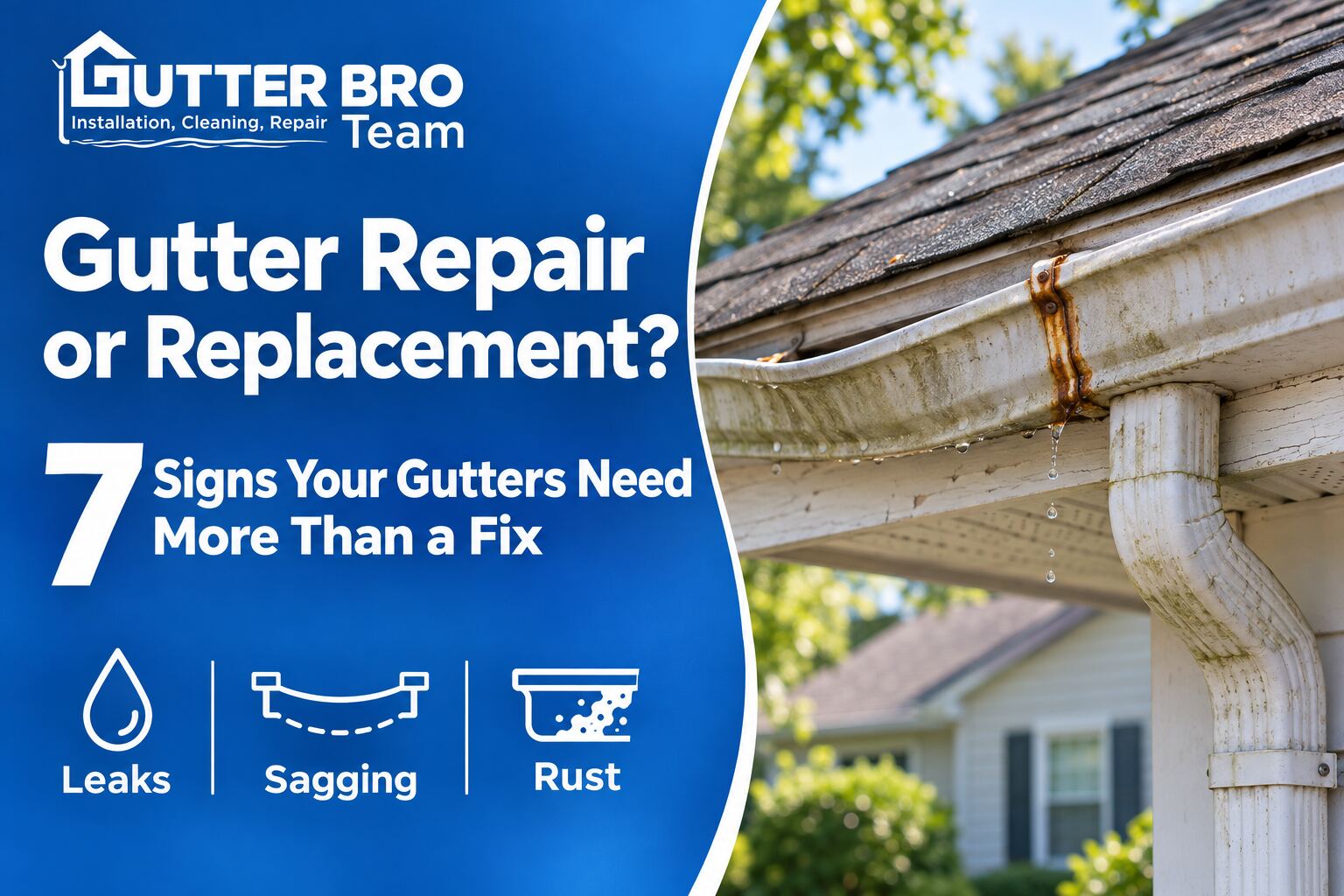
A loose hanger or a leaking seam is usually a quick fix. But when homeowners in Roswell, Alpharetta and the rest of North Atlanta call us after a storm, what looks like “just another repair” is sometimes the gutter system telling you it is near the end of its life. Knowing the difference saves money two ways — you avoid paying for a replacement you do not need yet, and you avoid sinking repair money into a system that is going to keep failing anyway. Here are 7 signs that point toward replacement rather than another patch job, plus a simple way to decide which route makes sense for your home.
A single sagging section, caused by one loose hanger, is a straightforward repair. But if multiple runs are sagging, or the whole gutter is pulling away from the fascia board along its length, the problem is usually bigger than the hangers. Years of standing water and debris weight can soften or rot the fascia itself, and re-hanging gutters to wood that can no longer hold a screw is a repair that will not last. Widespread sagging is one of the clearest signs the system should be replaced rather than re-hung piece by piece.
One crack can be sealed. Cracks, splits or small holes showing up in several places along the run usually mean the material itself is fatigued — from age, hail damage, or ladders and debris over the years. Sealing each spot one at a time becomes a cycle: new leaks keep appearing faster than they can be patched, and you end up paying for repairs several times over the cost of simply replacing the damaged sections or the whole system.
Older steel or galvanized gutters eventually rust from the inside out, especially where debris sits against the metal. Surface rust and light staining can sometimes be cleaned and treated, but once you see rust-through — actual holes or thin, flaking metal you can push a finger through — the gutter has lost its structural integrity at that spot, and it will keep spreading. Seamless aluminum does not have this problem, which is one reason most replacements in our area move to aluminum.
Every gutter in North Atlanta needs cleaning a few times a year under our pine and oak mix — see our guide to how often to clean gutters in Georgia. That is normal. What is not normal is a gutter that overflows again within weeks of a thorough cleaning. That usually points to incorrect slope, undersized gutters or downspouts for your roof, or so much sag that water pools instead of draining. A repair can sometimes fix the slope on one run, but if the whole system is undersized or was installed with the wrong pitch throughout, replacement is the only fix that actually solves the overflow for good.
Streaking or peeling paint under the gutter line, soft or rotting fascia board, or erosion and puddling along the foundation are all signs that water has been overflowing or leaking for a while, not just once. If the damage is limited to one short run, a targeted repair plus fascia work can solve it. If you are seeing staining or soil washout at several points around the house, it usually means the whole system has been failing quietly for a long time, and a full replacement stops the ongoing damage instead of chasing it spot by spot.
Sectional gutters are joined with seams, and seams are the most common place a gutter leaks. Resealing a seam once or twice is a normal, inexpensive repair. A seam that separates again a season or two later, especially more than one seam on the same system, tells you the sealant is fighting a losing battle against age, movement or expansion and contraction. Seamless aluminum gutters remove almost all of these mid-run seams in the first place, which is a major reason homeowners replacing an old sectional system upgrade to seamless — see seamless aluminum gutters for Georgia homes for how that works.
Age alone is not a reason to replace a gutter that is otherwise sound. But age combined with any of the signs above tips the scale toward replacement. Galvanized steel gutters often last 15 to 20 years before rust becomes a real problem, while properly installed seamless aluminum typically lasts 20 to 30 years. If your gutters are original to an older home and you are now seeing sagging, repeat leaks or rust on top of that age, you are very likely past the point where repair is the better value.
Exact pricing always depends on your home, but here is a general, honest picture of how the two options typically compare so you know what to expect before an estimate.
| Gutter repair | Gutter replacement | |
|---|---|---|
| Typical cost | Generally a smaller, one-time cost per visit, scaled to how many spots need fixing | A larger upfront cost, but priced per linear foot for the whole system |
| Best for | Isolated issues: one leaking seam, one loose hanger, a single damaged section | Widespread sagging, repeat leaks, rust-through, or a system near the end of its life |
| Long-term value | Lower cost now, but repeat repairs on an aging system add up over a few years | Higher cost now, but typically 20–30 years of service from seamless aluminum with little upkeep beyond cleaning |
| Good time to bundle | — | Pairs well with gutter guards, since both jobs share the same ladder access |
Repair is usually the right call when the problem is isolated: a single leaking seam, one section sagging because of a loose or missing hanger, a downspout that has come apart, or minor damage from a fallen branch. If the rest of the system is sound — no widespread rust, no repeat leaks elsewhere, no chronic overflow — a focused repair is the cheaper, faster option and there is no reason to replace a system that still has years of life left in it. Our gutter repair service covers exactly this kind of targeted fix.
Replacement starts to make more financial sense once repairs are happening more than once a year, once you are seeing two or more of the signs above at the same time, or once the gutters are old enough that any repair is really just buying a little more time on a system that is already failing. At that point, the math usually favors a full replacement with seamless aluminum: one job, a clean warranty, and 20 to 30 years before you are back in the same position. Our gutter installation and replacement service covers sizing, color matching and removal of the old system.
A few resources that can help you narrow down which route fits your home:
Look at how many problems you have and where. One isolated issue — a single leak, one sagging section — usually points to repair. Multiple signs at once, like sagging in several spots, repeat leaks after resealing, or rust-through, point to replacement.
A single repair almost always costs less upfront than a full replacement. But if you are paying for repairs more than once a year on an aging system, the repeated repair cost can approach or exceed what a replacement would have cost, without ever actually solving the underlying problem.
Sometimes. If the damage is limited to one run and the rest of the system is in good shape, a partial replacement can work. If the gutters are old or you are seeing problems in several areas, a full replacement is usually a better long-term value, especially with seamless aluminum.
Properly installed seamless aluminum gutters typically last 20 to 30 years in Georgia’s climate, with regular cleaning. See seamless aluminum gutters for Georgia homes for more on lifespan and sizing.
Yes. Guards do not replace the need for a sound gutter system, but pairing new gutters with guards cuts down on future clogging and extends the time between cleanings, which protects your investment.
That is exactly what we recommend. A short inspection usually makes it clear which option actually solves the problem, so you are not guessing. Book a free estimate and we will give you both options honestly.
Gutter Bro Team repairs and replaces gutters across Roswell, Alpharetta, Milton, Johns Creek, Marietta, Sandy Springs, Woodstock and North Atlanta. We will inspect your system and tell you plainly whether a repair is enough or whether replacement is the better long-term value — not whichever is more profitable for us. Call (470) 240-0052 or book a free estimate online.


